

Abstract
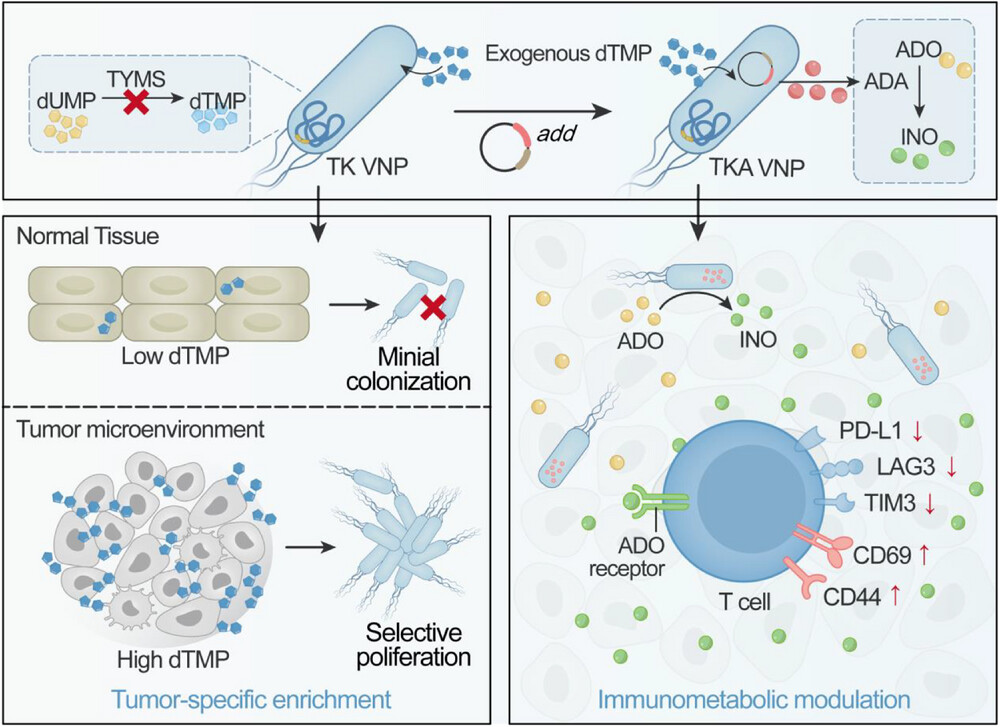
Bacterial therapy offers unique advantages in tumor targeting and intratumoral payload delivery, yet its clinical translation remains hampered by limited selectivity and systemic toxicity. Here, we constructed a thymidine-auxotrophic strain of Salmonella typhimurium (TK VNP), in which bacterial growth is strictly dependent on exogenous deoxythymidine monophosphate (dTMP). We show that dTMP is consistently enriched in the tumor microenvironment (TME) due to high nucleotide turnover and cell lysis, enabling TK VNP to selectively proliferate in the tumor while minimizing colonization in normal organs. This metabolic dependency enhanced systemic safety and improved the tumor-targeting index by nearly tenfold compared with the parental strain. On this safety-enhanced chassis, we introduced an adenosine degradation module to express adenosine deaminase (ADD) in different localizations-cytoplasmic (cTKA VNP), secreted (sTKA VNP), and surface-anchored (wTKA VNP) to metabolize immunosuppressive adenosine (ADO) into inosine (INO). These strains efficiently promoted CD8+ T cell infiltration and activation, and reduced exhaustion markers such as PD-1 and TIM-3. Moreover, TKA VNP synergized with immune checkpoint blockade and radiotherapy to induce durable tumor regression. This work establishes a metabolically gated bacterial therapeutic platform that integrates tumor-restricted replication with localized immunometabolic modulation, addressing key challenges in the safe and effective clinical application of bacterial cancer therapies.